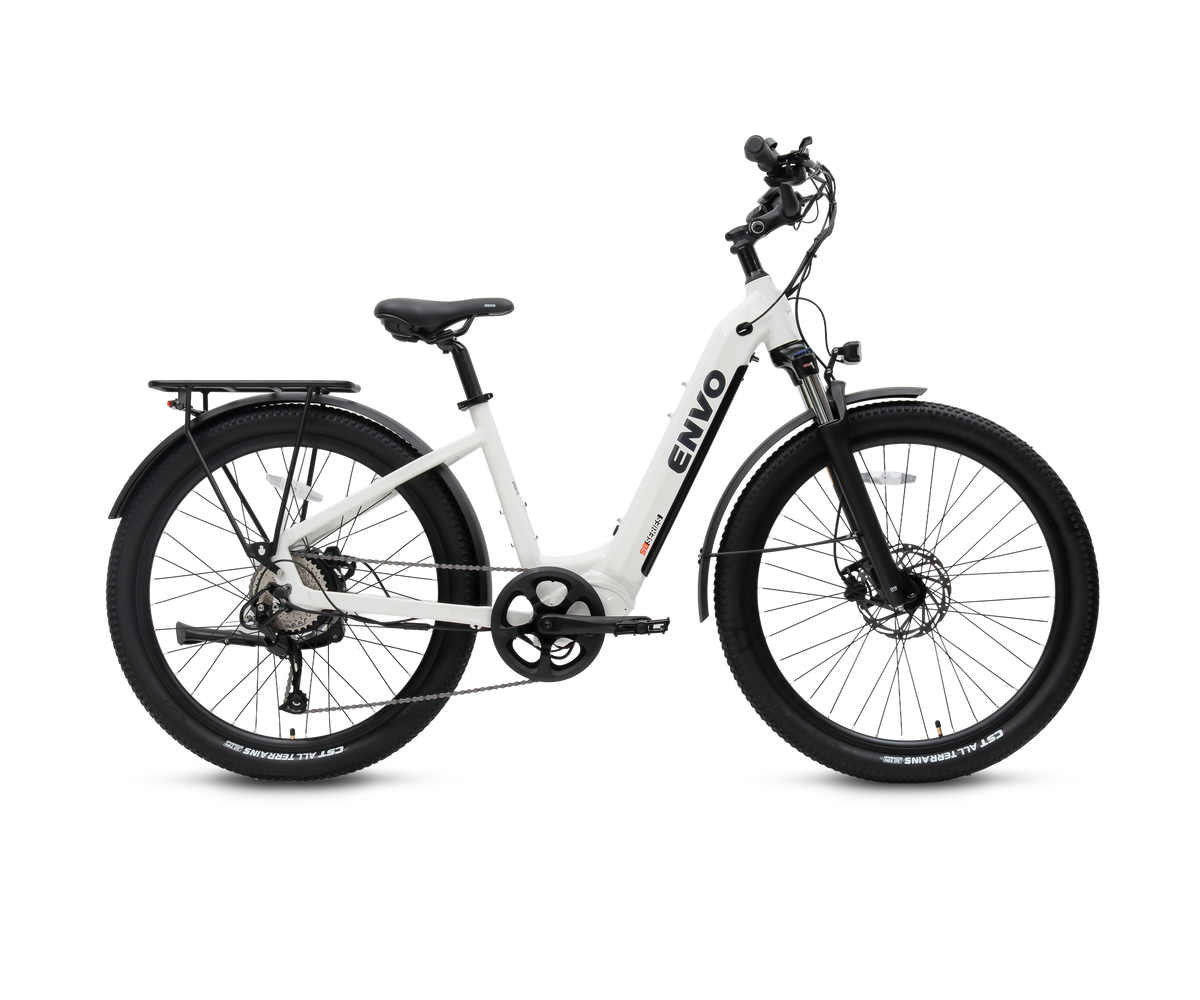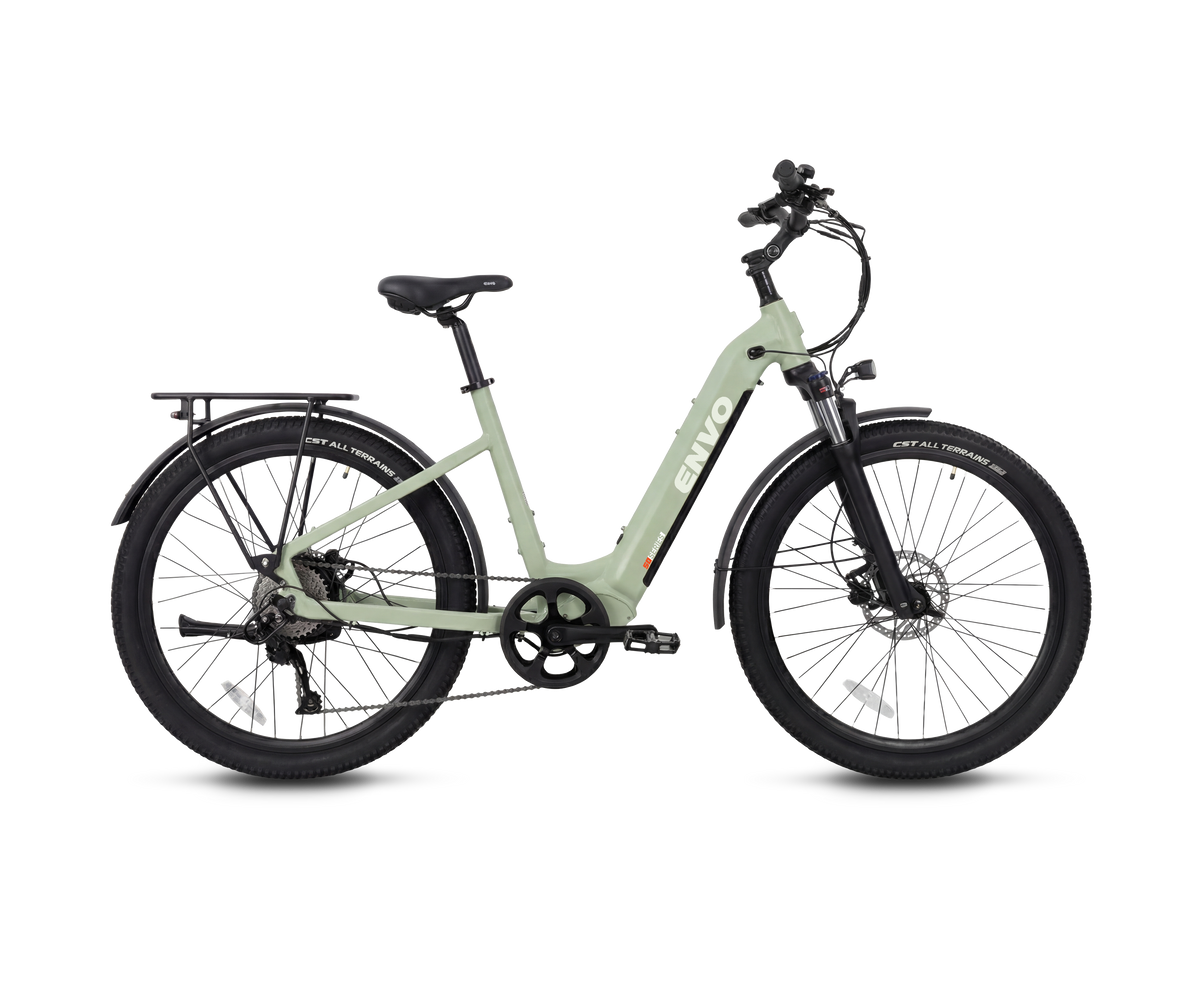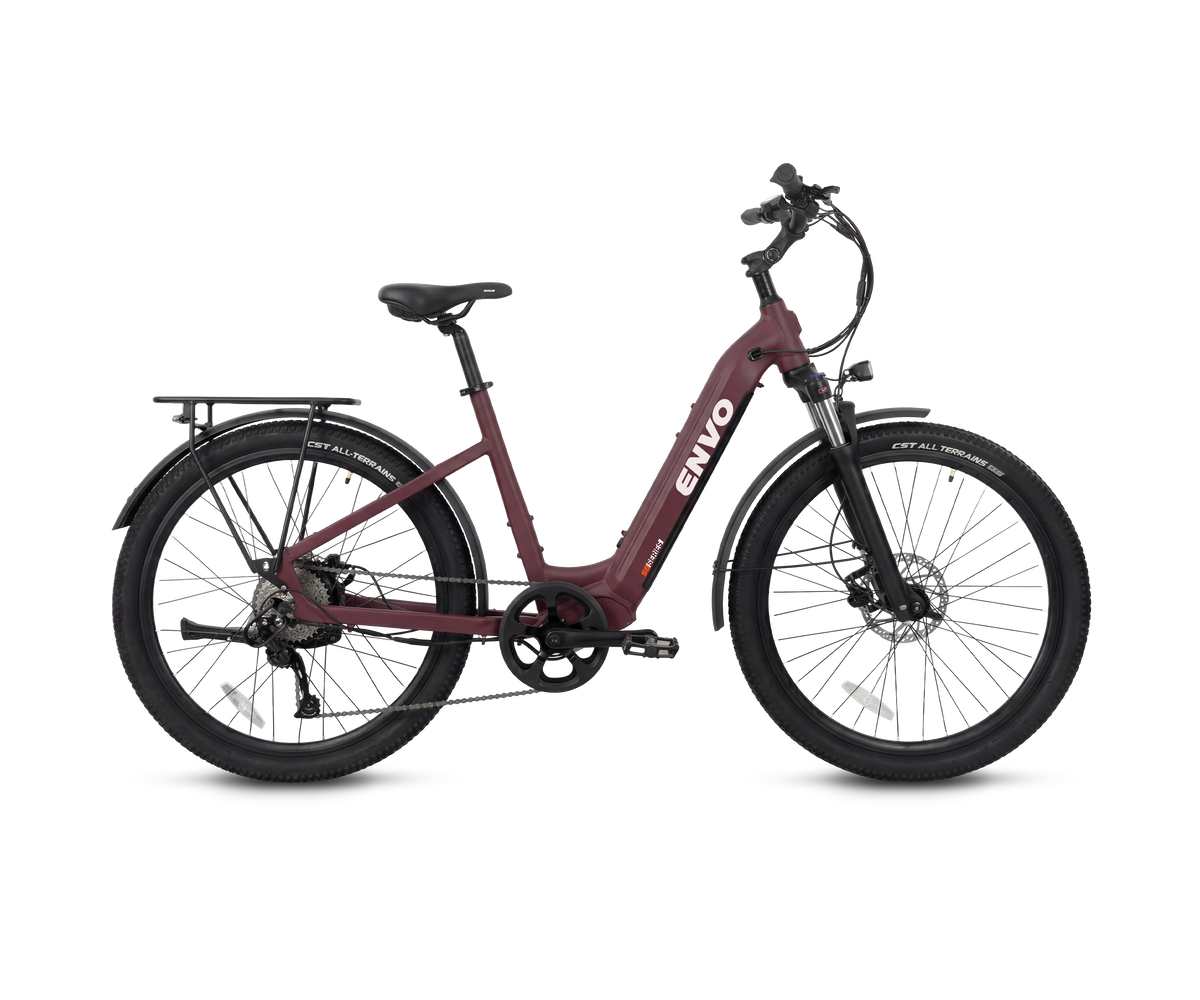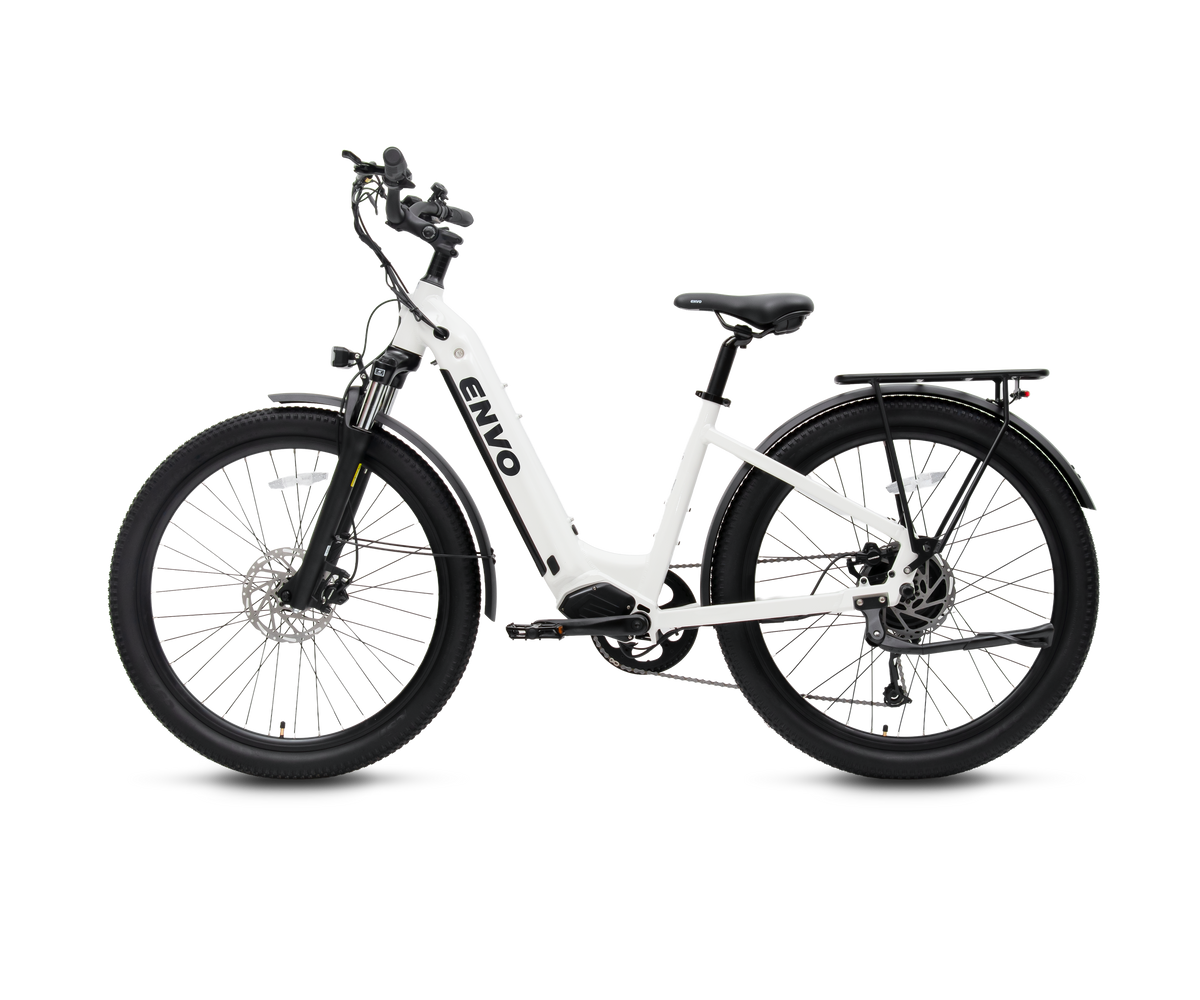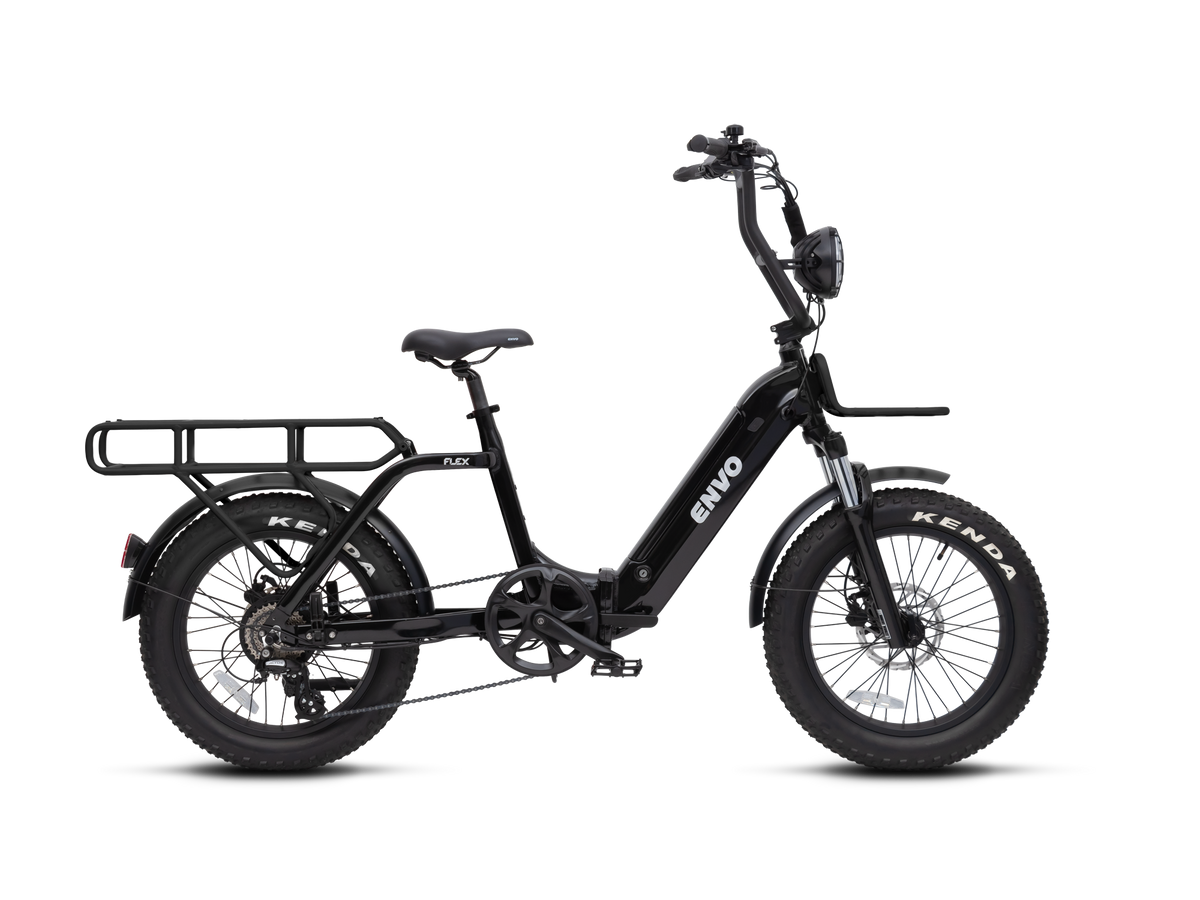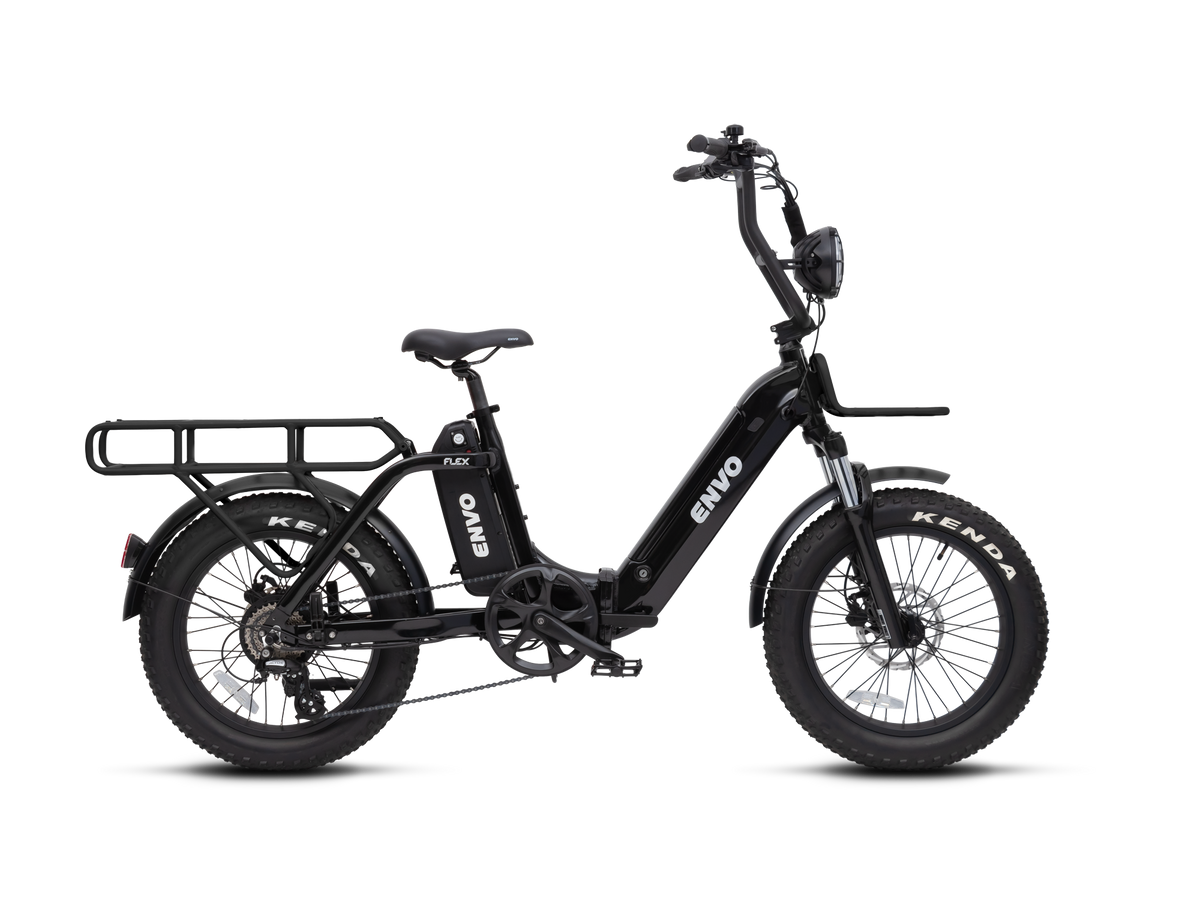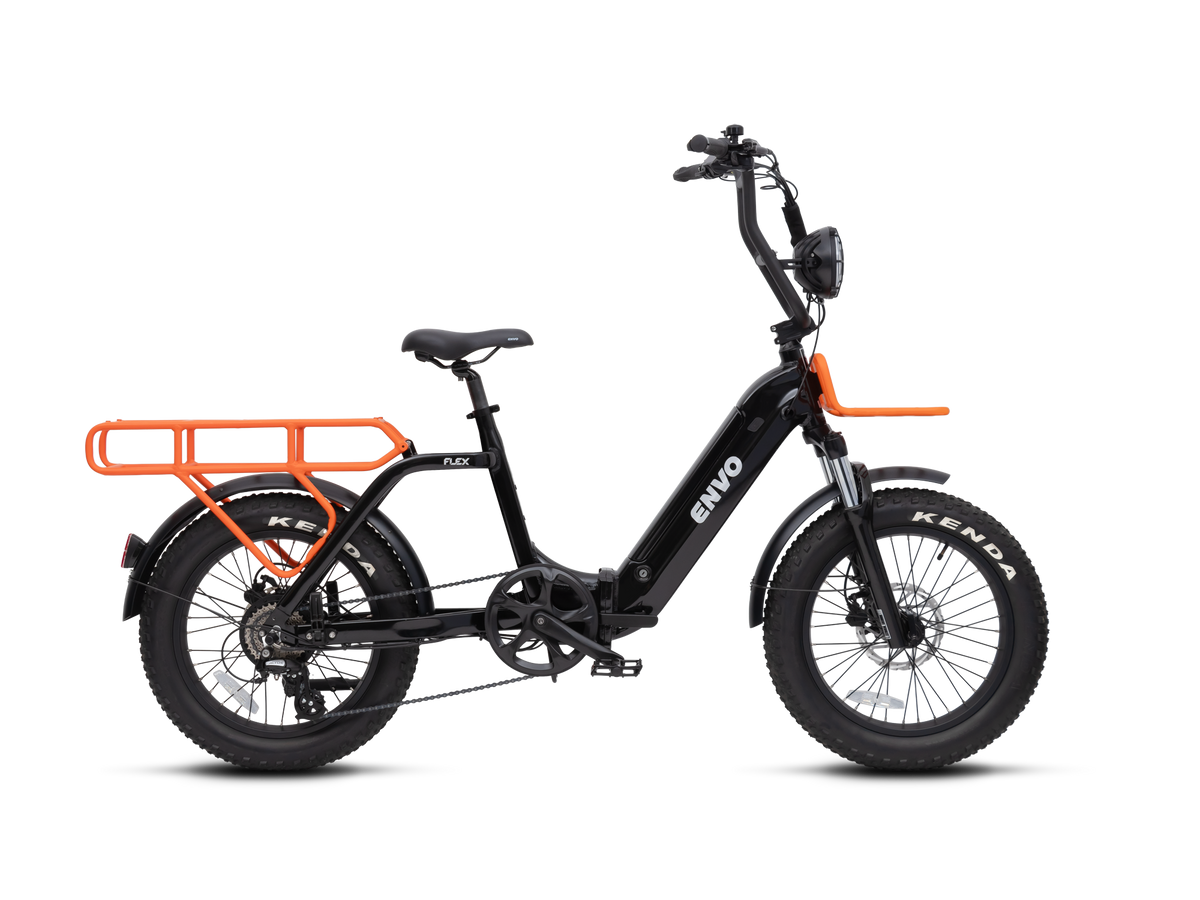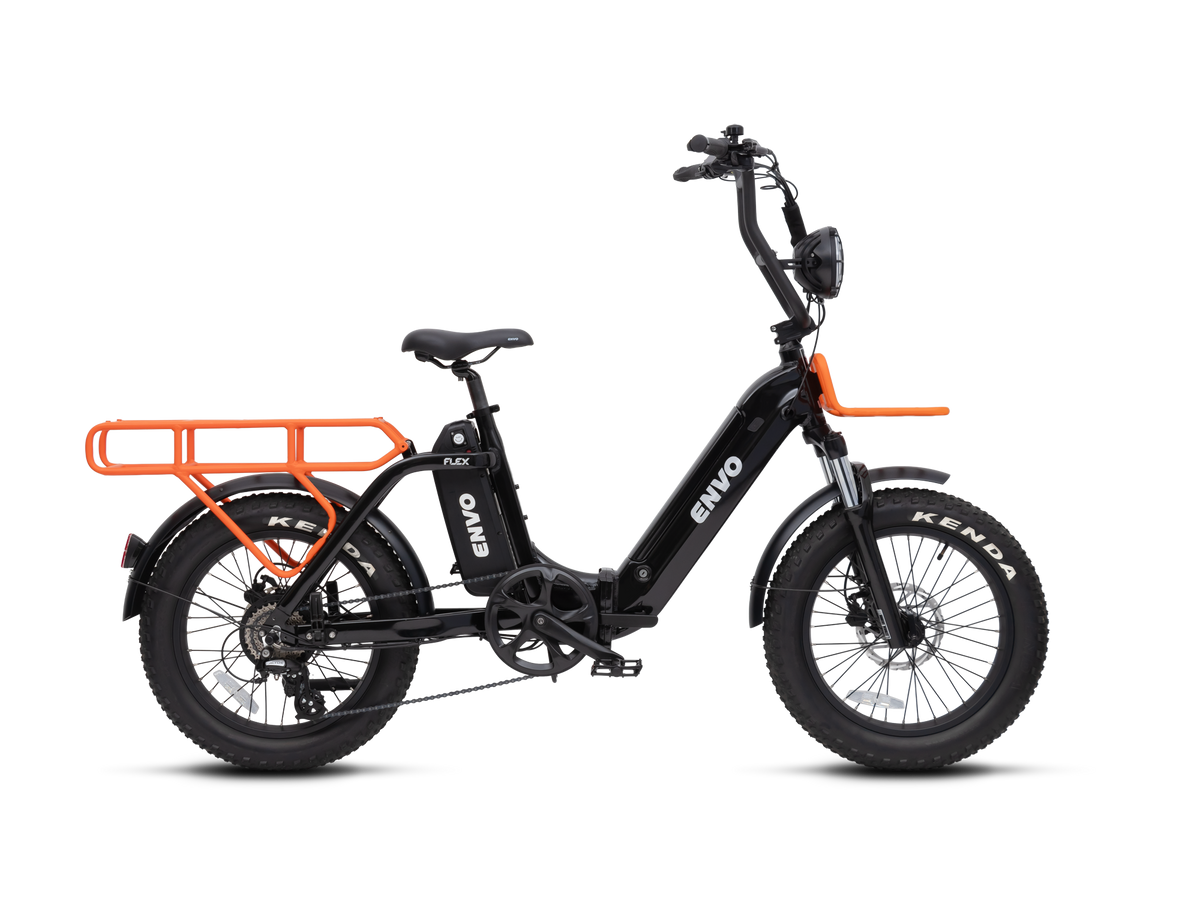

ENVO D50 vs Aima Big Sur G2 15Ah
A 28 kg Canadian-made performance hybrid vs a 37 kg Chinese fat-tire styled step-thru — same battery, same torque, very different ownership stories.
Quick Verdict
If you're comparing the ENVO D50 and the Aima Big Sur G2 15Ah, you're actually looking at two bikes that are closer on paper than they first appear. Same 500W rear hub, same 80Nm of torque, same 720Wh battery, same Tektro hydraulic brake family, and both UL 2849-certified. On raw spec headline alone, this is not a blowout — but the ownership story diverges sharply.
Price & Positioning
At current pricing, the ENVO D50 comes in at $2,679 CAD, while the Aima Big Sur G2 15Ah sits at $2,990 CAD. That's a price gap of $311 CAD.
For that extra money, Aima asks you to prioritize a step-thru frame, fat-tire-inspired all-terrain styling, a stronger written warranty, and the confidence some buyers feel seeing named suppliers like Bafang and Shimano on the spec card.
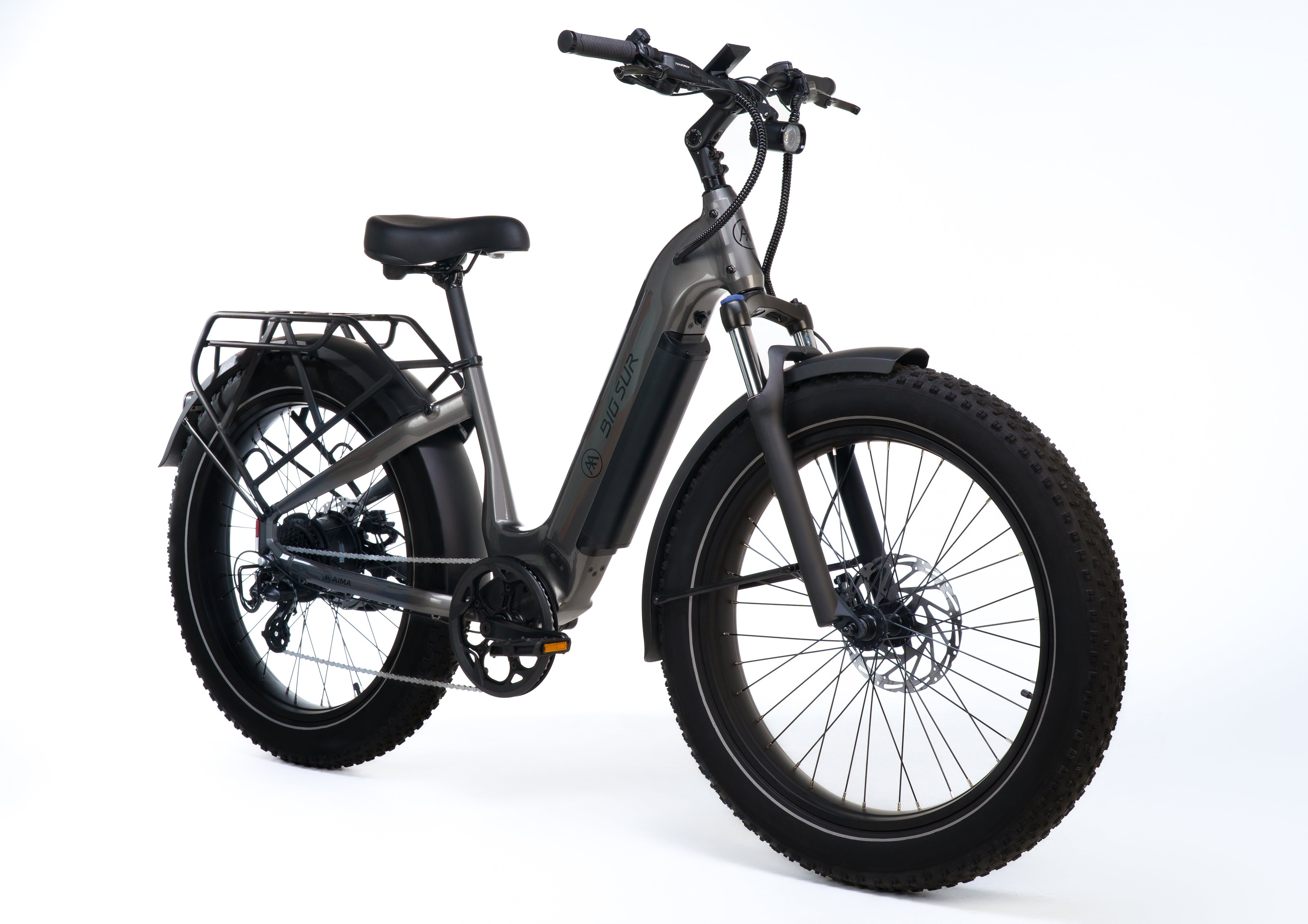
That's not irrational. Many Canadian buyers genuinely want a lower, more approachable frame and a bike that looks ready for gravel paths, cottage roads, and mixed surfaces. The Aima Big Sur G2 leans into the current Canadian appetite for fat-tire-styled, step-thru, all-terrain e-bikes, and it does the job.
But at this price point, the harder question is whether those visual and warranty benefits outweigh what ENVO gives you for less money: 9 kg less weight, higher top-speed capability, dual battery support, and local Canadian design and assembly backing.
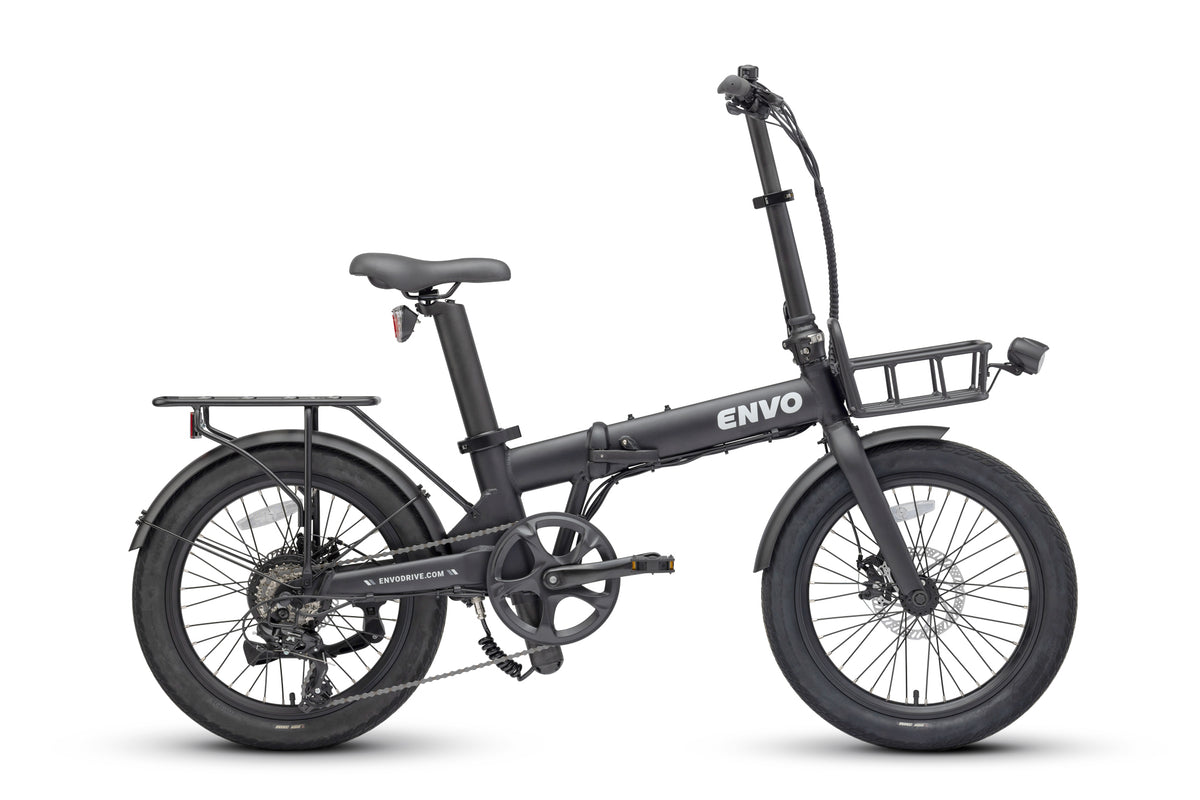
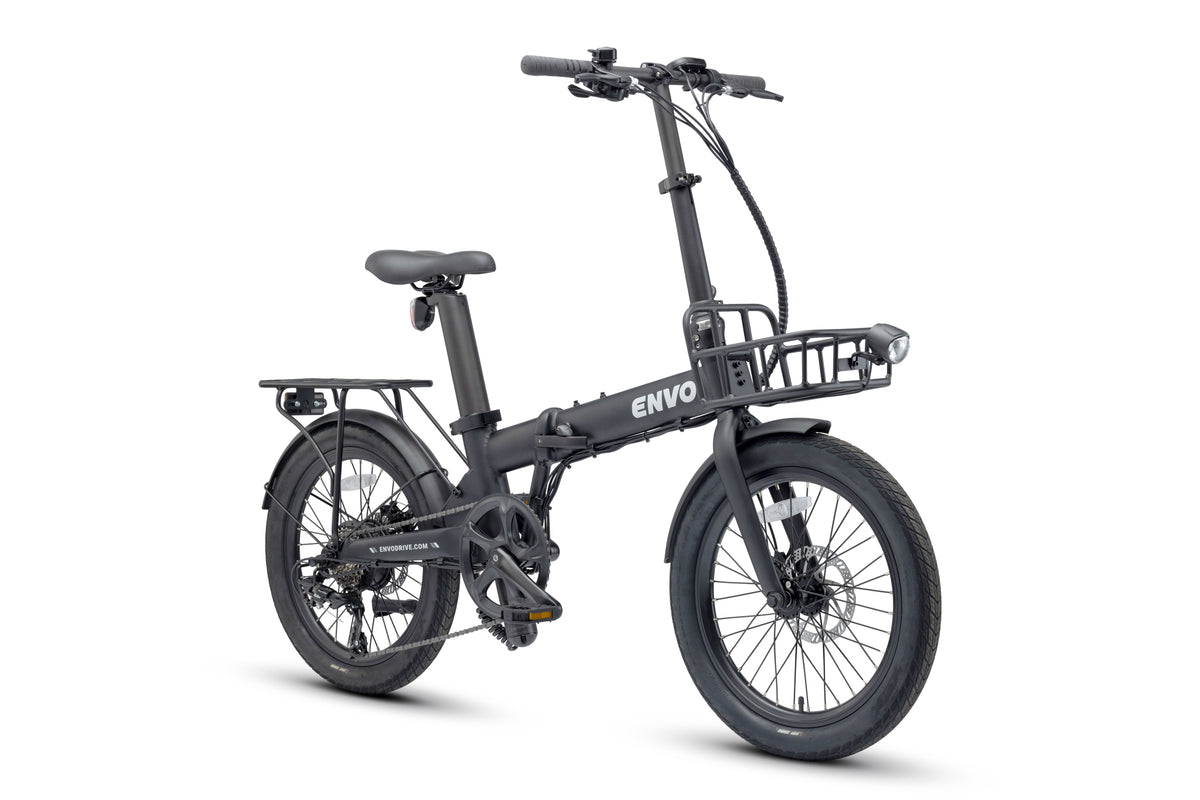
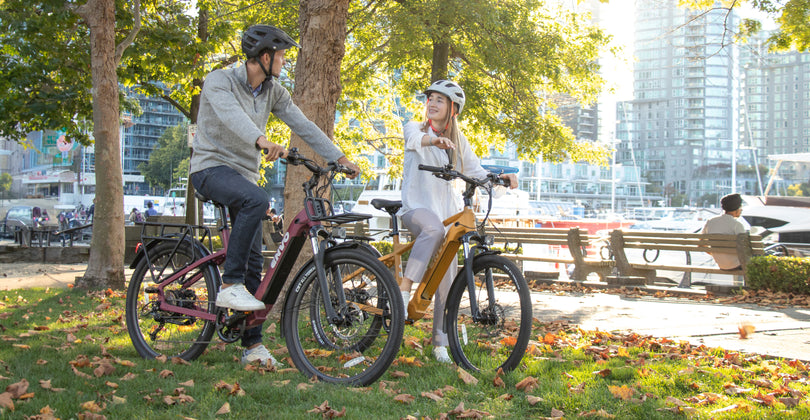
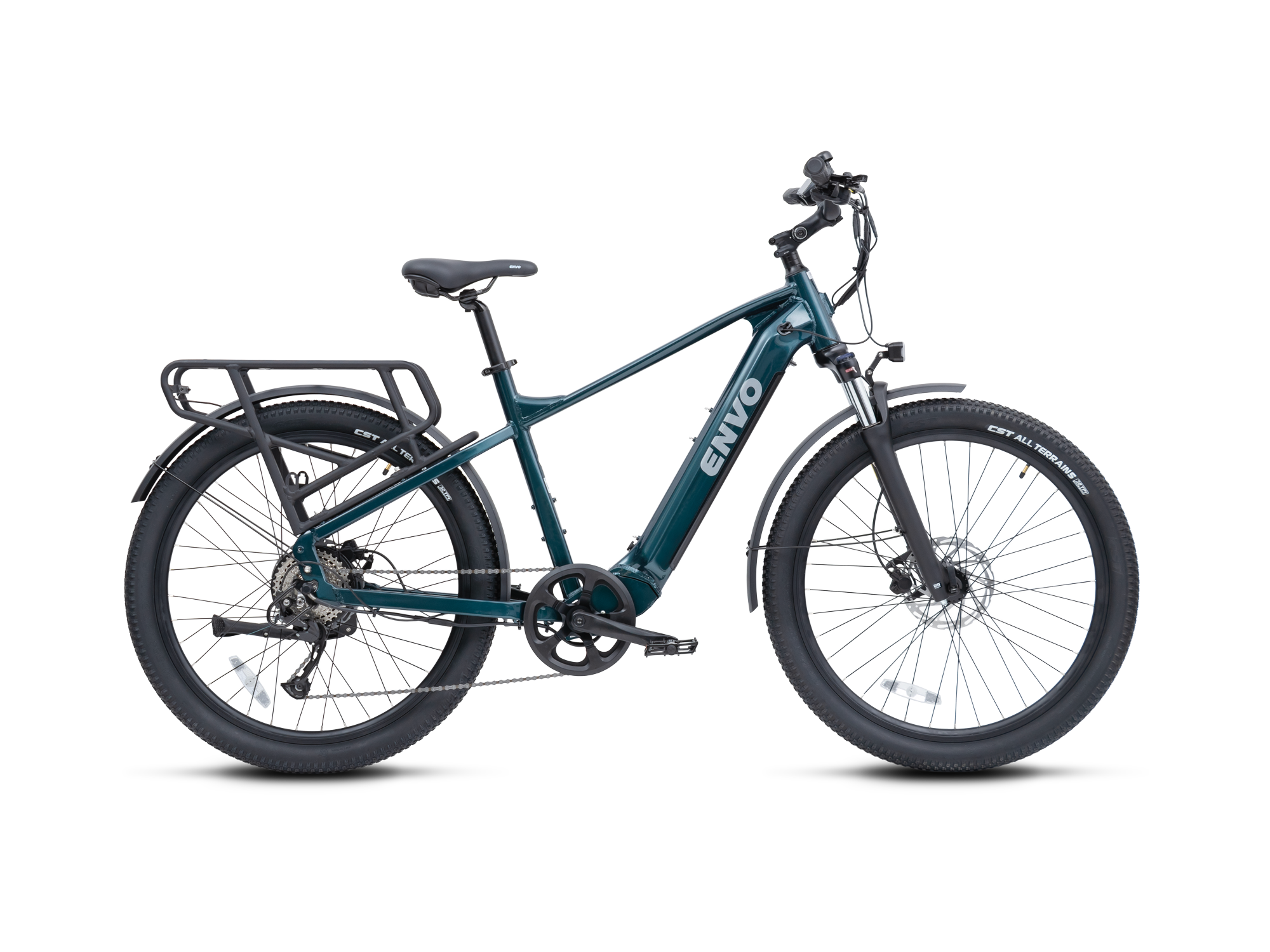
The ENVO D50 is more of a performance-minded, traditional-frame commuter/adventure hybrid. It gives up the low-step format and fat-tire aesthetic, but in return it brings some meaningful advantages for buyers thinking about long-term ownership in Canada. For more context, see our overview of the best all-terrain electric bikes currently sold in BC.
That's really the story here: same buyer profile, two different priorities.
Full Spec Comparison Table
| Specification | 🇨🇦 ENVO D50 | 🇨🇳 Aima Big Sur G2 15Ah |
|---|---|---|
| Price (CAD) | $2,679 | $2,990 |
| Motor | 500W rear hub · 80 Nm | Bafang G062 500W rear hub · 80 Nm |
| Battery | 48V / 15Ah · 720 Wh | 48V / 15Ah · 720 Wh |
| Claimed Range | Up to 150 km (Class 2) · 70 km (Class 3) | 45–80 km (across assist levels) |
| Top Speed | 45 km/h (Class 3) · 32 km/h (Class 2) | 32 km/h (Class 2 only) |
| Weight | 28 kg — 9 kg lighter | 37 kg |
| Payload Capacity | 200 kg | 180 kg |
| Gears | 9-speed | Shimano Acera/Altus 8-speed (entry-tier) |
| Tires | Disclosed on product page | Brand not disclosed |
| Frame Style | High-step diamond | Step-thru (low-step accessibility) |
| Sensor System | Torque + Cadence (dual-sensor) | Bafang SR PA242 torque-only |
| Brakes | Tektro E3520 hydraulic disc | Tektro E3520 hydraulic disc · 203mm rotors |
| Fork | 29" 80mm suspension | Zoom 80mm suspension · locking lever |
| Display | Color display · Bluetooth app · CAN | Bafang DP C010 color TFT · navigation |
| Dual Battery | Supported (up to ~1,440 Wh) | Not supported |
| UL 2849 Certified | Yes | Yes |
| Warranty | 1 year | 2 yr frame · 2 yr power-assist · 2 yr/300 cycle battery · 1 yr mechanical |
| Canadian Market Tenure | Since 2016 (~9 years) | Since Nov 2024 (~18 months) |
| Origin / HQ | Designed, engineered & assembled in Burnaby, BC 🇨🇦 | Designed, engineered & manufactured in China · HQ: City of Industry, CA · Canadian distributor UNIVELO |
Motor & Performance
On headline output, these bikes are essentially identical.
The ENVO D50 uses a 500W rated rear hub motor with 80 Nm of torque. The Aima Big Sur G2 15Ah uses a Bafang G062 500W rear hub motor, also rated at 80 Nm of torque.
If you're just reading spec cards, both bikes promise a very similar level of low-speed push. Many shoppers assume the Aima — because of its bigger, more aggressive all-terrain presence — must be dramatically more powerful. Based on the verified manufacturer specs, that is not really the case.
Where ENVO Pulls Ahead
The D50 can run as Class 2 (32 km/h) or Class 3 (up to 45 km/h). The Aima Big Sur G2 is Class 2 only.
That matters more than it sounds. A higher-speed envelope gives the ENVO more room for faster road commutes, easier pace-matching in open bike-lane stretches, and a better fit for riders covering longer suburban distances. If you ever ride suburban arterials or want to keep up with traffic in a 40 km/h zone, the Class 3 ceiling becomes a genuine quality-of-life advantage. For more on the legal classes and what they mean in Canada, see our guide to e-bike classes in Canada.
So the headline numbers are the same — but the usable performance envelope is wider on the ENVO.
⚡ Performance Read: Both bikes share 500W output and 80 Nm of torque. The decisive difference is the speed ceiling: ENVO offers a Class 3 unlock to 45 km/h, while the Aima is locked to 32 km/h Class 2.
Range & Battery
Both bikes carry the same 48V 15Ah / 720 Wh battery. On paper, this should be a flat tie. And yet the claimed range figures diverge significantly:
- ENVO D50: up to 150 km in Class 2, ~70 km in Class 3
- Aima Big Sur G2 15Ah: 45–80 km depending on assist level
There are a few honest ways to interpret this gap: different test methodologies, platform efficiency differences (the Aima's heavier 37 kg build and fat-tire orientation may simply be less efficient), or conservative vs aggressive range marketing styles between the two brands.
Even allowing for those differences, the ENVO is clearly marketed as the more range-efficient platform. A 720 Wh pack on a 28 kg frame with thinner tires is going to roll further than the same pack on a 37 kg frame with knobbier rubber. Physics rewards the lighter bike.
Dual Battery — Only ENVO Offers It
This is one of the underappreciated D50 advantages. ENVO supports a dual-battery setup, effectively taking total available energy to around 1,440 Wh. The Aima Big Sur G2 does not offer that option.
For long-distance commuters, cottagers, gravel adventurers, or buyers who simply hate range anxiety, that doubling matters. It changes the bike from "weekend ride" to "all-day touring" in a single accessory upgrade. For more on this kind of expandability, see ENVO's dual-battery range guide.
Aima — Same 720 Wh, Less Range
720 Wh · 45–80 km claimed · Heavier frame and fat-tire styling reduce efficiency. No dual-battery option.
ENVO D50 — More Range, More Expandable
720 Wh · up to 150 km Class 2 · Dual-battery support takes the platform to ~1,440 Wh.
Frame & Weight — The Biggest Real-World Difference
This is the section where the comparison stops being abstract.
- ENVO D50: 28 kg
- Aima Big Sur G2 15Ah: 37 kg
That's a 9 kg difference. On a spec sheet, some buyers shrug at that. In actual ownership, it's huge.
A 9 kg gap changes how easy the bike is to move around in a garage, how annoying it is to push up stairs or ramps, how manageable it feels on a hitch rack, how quickly it responds to steering at low speed, and how lively it feels when pedalling with assistance reduced.
The Aima's extra mass isn't there by accident. A heavier step-thru all-terrain-styled platform may reflect a design built around visual robustness, rider confidence, and fat-tire use priorities. So this isn't necessarily "bad engineering." It may simply be the cost of that category.
But for many Canadian buyers, especially urban and suburban ones, 37 kg is a lot of bike. Lifting it onto a car rack, hauling it up a flight of condo stairs, or wrestling it through a basement door becomes a meaningfully harder task than doing the same with a 28 kg D50.
Frame Style — The Aima's Counter-Argument
The Aima wins one column here clearly: accessibility. Its step-thru frame is easier to mount and dismount, has lower standover stress, and is more forgiving for riders wearing bulkier winter clothing or carrying groceries. Older riders, riders with hip mobility limitations, and shorter riders often genuinely prefer a step-thru.
The ENVO D50 is a high-step diamond frame. It is the more performance-oriented, athletic-feeling shape — but it requires lifting a leg over the top tube.
So the frame question is real: do you value low-step accessibility more, or do you value 9 kg less weight more? For many urban Canadian buyers, the weight saving wins. For mobility-sensitive buyers, the step-thru wins. Both choices are legitimate. Browse our wider step-thru e-bike collection if accessibility is your priority.
⚖️ Real-World Read: The 9 kg weight delta is the single most impactful spec difference between these bikes. It affects every part of daily ownership — carrying, racking, storing, pedalling unassisted. The Aima's step-thru frame is the one thing that meaningfully counters it.
Sensor & Ride Feel
Beyond pure performance numbers, the way each bike delivers assist is shaped by its sensor setup:
- ENVO D50: torque + cadence (dual-sensor)
- Aima Big Sur G2 15Ah: torque-only (Bafang SR PA242)
A torque sensor generally gives more natural assist — power scales with how hard you actually push the pedals. The Aima's torque-only approach is not a weakness in itself; it's a competent, recognizable system.
What ENVO's dual-sensor setup gives you is more flexibility. Combining torque with cadence opens up a broader tuning window for different rider preferences. You can get the natural pedal-feel of torque sensing plus the consistent, predictable push of cadence sensing, depending on how the controller is configured. For mixed riders — commuter on Monday, leisure rider on Sunday — this versatility is genuinely useful. See our torque vs cadence sensor explainer for more.
So Aima's setup is fine. ENVO's is simply more versatile on paper.
Ride Quality & PAS Responsiveness
Spec sheets miss what reviewers and dealers consistently flag about ENVO: ride feel that doesn't show up in numbers. ENVO's pedal-assist behaviour has been iterated on for years — power delivery is tuned to feel natural, predictable, and well-matched to Canadian commuter and trail use. Aima is using essentially off-the-shelf Bafang tuning out of the box.
The D50's controller logic, throttle ramp, and PAS curves are tuned specifically for how Canadians actually ride. On a heavier 37 kg bike like the Big Sur G2, stock Bafang tuning can feel laggy or unrefined — especially at low-speed manoeuvres in city traffic.
🚴 Test ride reveals the difference: Five minutes on each bike makes the gap obvious. ENVO's assist feels engineered. Aima's feels stock.
Components & Build
This is the most evenly split section. Each bike wins some columns and loses others.
Brakes
Both bikes use the Tektro E3520 hydraulic disc family. Aima specifies 203mm rotors — a nice confidence point for a heavier bike.
Drivetrain
ENVO runs a 9-speed drivetrain. Aima runs Shimano 8-speed. ENVO has the extra gear; Aima has the more famous brand stamp.
Sensors
ENVO uses torque + cadence dual-sensor. Aima uses Bafang torque-only. ENVO is more versatile; Aima is simpler.
Display
ENVO offers a color display with Bluetooth app + CAN. Aima counters with the Bafang DP C010 color TFT with navigation.
Fork
Both run 80mm-travel budget suspension forks. Aima's Zoom unit adds a lockout lever — a useful feature for paved riding.
Payload
ENVO carries up to 200 kg. Aima rates 180 kg. The lighter ENVO actually hauls more.
Aima looks stronger in component branding clarity: Bafang motor, Bafang display, Shimano drivetrain — all easy-to-recognize industry names. That's a real comfort signal for buyers shopping a spec sheet.
ENVO looks stronger in payload, drivetrain detail, system integration, and dual-battery expandability. The CAN-bus architecture and Bluetooth app are part of an integrated approach rather than a parts-bin assembly.
Neither is a knockout. Both bikes are reasonably specced for the $2,679–$2,990 bracket. One note on Aima's drivetrain: it's Shimano Acera/Altus — entry-tier, below Alivio and Deore in the Shimano hierarchy. The "Shimano 8-speed" headline reads better than the actual component grade.
Geometry & North American Fit
Reviewers consistently note that Aima frame geometry feels designed for the Chinese domestic market — reach, stack, and seatpost angles can feel off to riders accustomed to bikes geometry-tuned for Canadian/US sizing. ENVO frames are designed and engineered in Burnaby, BC specifically with North American riders in mind: taller average heights, longer torsos, different riding postures. It's the kind of detail that becomes obvious in the first 5 minutes of a test ride.
Tires & Aesthetics
Tires: Aima's Canadian product pages do not disclose the tire manufacturer — just generic "e-bike rated casing" language. ENVO discloses tire choices on product pages. Tire brand matters for replacement, ride feel, and puncture protection.
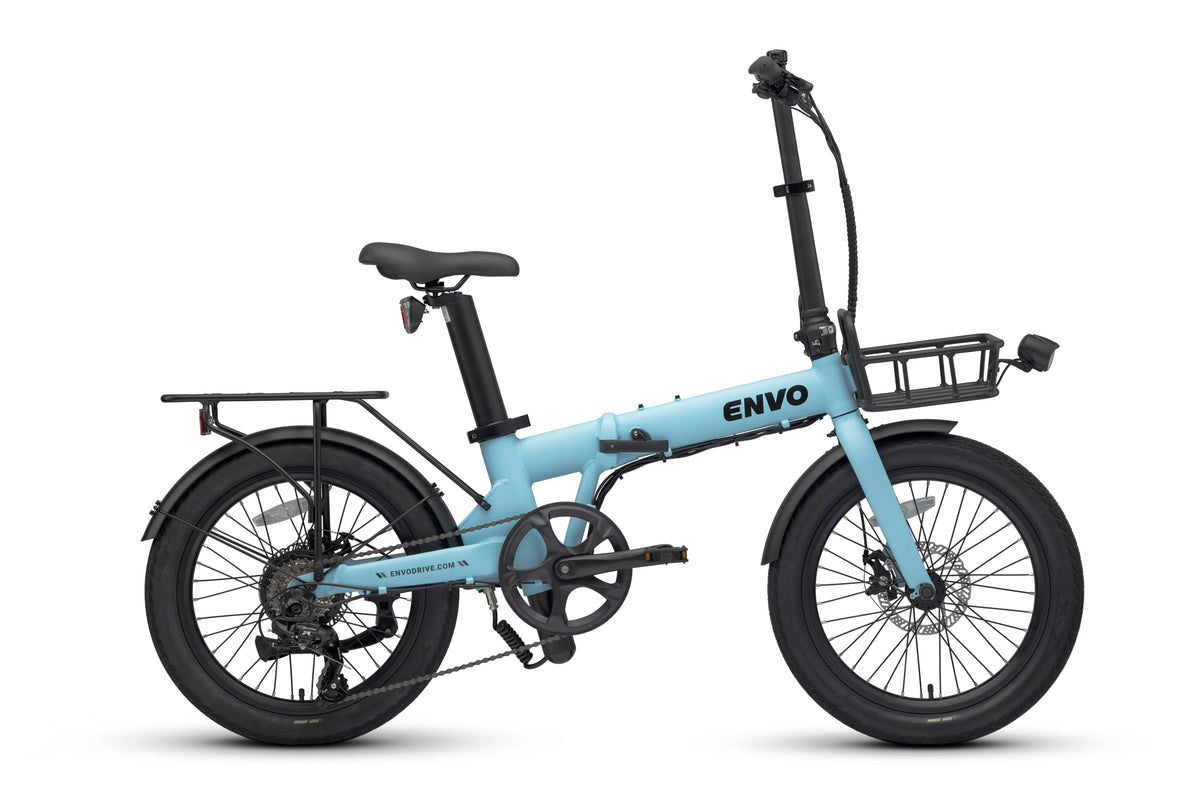
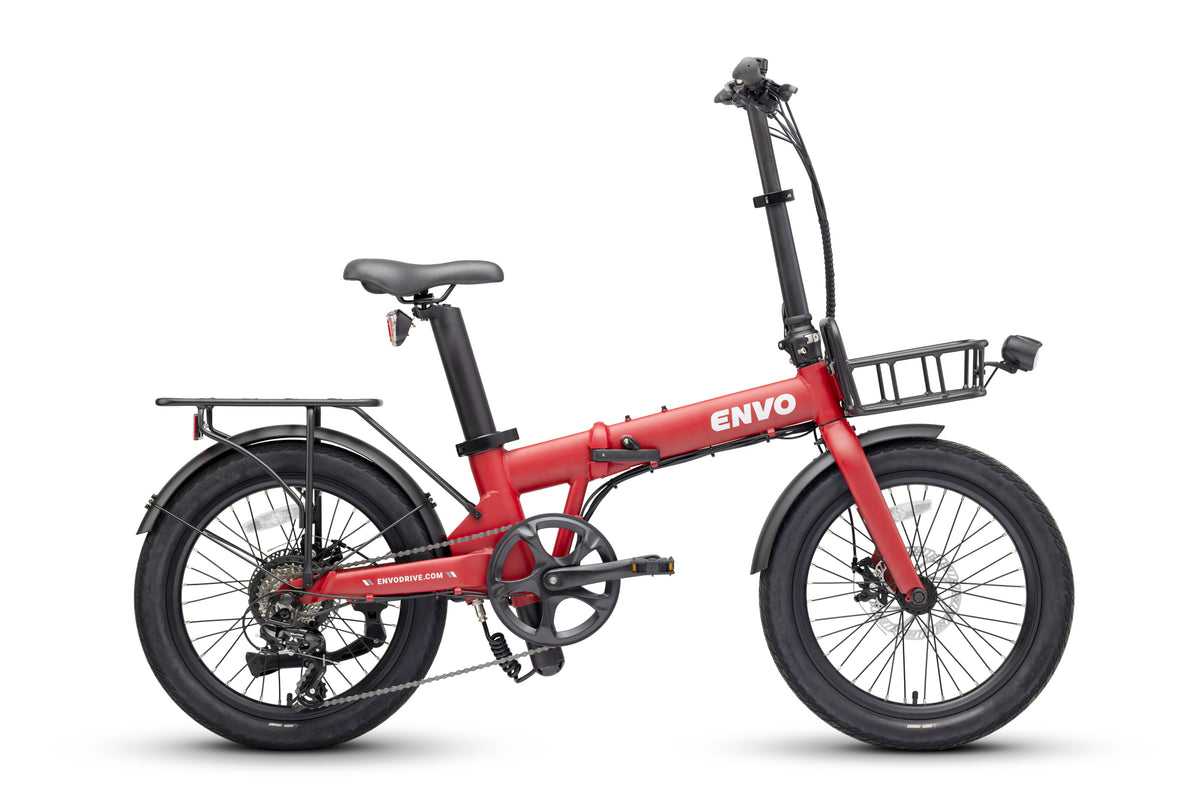
Aesthetics: Style is subjective, but the design language differs noticeably. ENVO leans sleek and considered — Canadian engineering aesthetics. The Big Sur G2 leans more utilitarian and, with 9 kg more mass than the D50, looks visibly bulkier. Worth a look in person before you decide.
For more on what matters when reading e-bike spec sheets, see our e-bike buying guide.
Safety & UL 2849
Safety-minded buyers should notice that both bikes are presented as UL 2849-certified systems.
ENVO's product page explicitly states UL 2849 certification for the D50. Aima's Canadian launch announcement also stated that all models in its Canadian lineup are certified to meet UL 2849 standards. You can browse other UL-certified e-bikes here for additional context.
That is good to see from both sides. In 2026, system-level electrical safety certification matters for more than a marketing checkbox. It increasingly matters for insurance coverage and condo board policies — many buildings now require UL 2849 certification before allowing an e-bike inside.
The more subtle difference is not the certification claim itself, but the market history behind it. ENVO has the benefit of being a longer-established Canadian operator with multi-year safety record visibility. Aima's Canadian rollout is much newer — about 18 months in the market as of May 2026.
That does not mean Aima is unsafe. It just means the Canadian ownership safety record is shorter, and there's less independent data to look at.
Warranty Comparison
This is one place where Aima plainly wins on paper.
🇨🇳 Aima Big Sur G2 Warranty
- ✅ 2 years frame
- ✅ 2 years power-assist
- ✅ 2 years or 300 cycles battery
- ✅ 1 year mechanical
🇨🇦 ENVO D50 Warranty
- ✅ 1 year coverage
- ✅ Canadian-based warranty administration
- ✅ Burnaby, BC operations centre
- ✅ Near-decade of in-market support history
That is a substantial difference, and it should be acknowledged clearly. If you are only comparing written warranty terms, the Big Sur G2 is more generous.
But warranty value is not just the number of months printed in a chart.
A longer warranty is only as useful as the company's ability to administer parts, approve claims, and keep service channels alive over multiple years. ENVO Drive Systems's support case is easier to understand because the brand has deeper Canadian roots, a Burnaby, BC operating base, and an established parts and service flow.
Aima's Canadian support currently runs through UNIVELO, the exclusive Canadian distributor announced on November 28, 2024, plus its dealer network. That arrangement can absolutely work — plenty of brands operate through distributors. But it introduces a long-term dependency: if the distributor relationship changes, shrinks, or struggles with parts flow, the consumer experience can become harder than the written warranty suggests.
So yes, Aima wins the warranty chart. But ENVO may still win the warranty confidence test for a buyer thinking several years out. For ongoing care, see ENVO's e-bike maintenance tips.
The Long-Haul Question
⚠️ Aima's product is not the problem. The long-haul Canadian support picture is the question.
Aima may be a large global manufacturer, but its actual Canadian market presence is still very new.
Aima's Canadian launch via UNIVELO was announced on November 28, 2024. As of May 2026, that means Aima has had roughly 18 months in the Canadian market. The launch was through an exclusive distributor, and the announcement positioned availability through partner retailers rather than Aima-owned retail or service infrastructure.
Aima's parent company is real scale — founded in 1999, publicly listed in Shanghai under ticker 603529. The bikes are designed in China, engineered in China, AND manufactured in China — the full trifecta. It is not a fly-by-night operation. But scale abroad does not automatically equal deep commitment in Canada.
As of May 2026:
- Aima's North American HQ is in City of Industry, California — there is no Aima legal entity in Canada
- Aima has been in Canada for only about 18 months via UNIVELO (a third-party distributor)
- There are no Aima-owned Canadian retail or service locations — and even Aima USA cannot directly service Canadian customers
- If UNIVELO loses the contract, there is no fallback
- Aima's 2024 overseas revenue was RMB 234.7 million out of RMB 21.61 billion total — roughly 1.1% — meaning international markets remain a very small share of the parent business
🇨🇦 Buy Canadian = buy ENVO. ENVO is designed in Burnaby, engineered in Burnaby, assembled in Burnaby — Canadian-owned. Aima is the opposite: Chinese trifecta + California HQ + Canadian distributor middleman.
That last point matters. If overseas business is a tiny fraction of total revenue, buyers should at least ask whether Canada remains strategic enough for aggressive long-term service investment.
ENVO, by contrast, was incorporated in 2016, operates from Burnaby, BC, and has built production and distribution capacity there. If you plan to keep this bike until 2030 or beyond, which support network are you more confident will still feel easy, local, and responsive in Canada?
For many buyers, ENVO's nearly-decade-long Canadian operating presence is going to be the more reassuring answer. Browse the wider EbikeBC catalogue for more Canadian-supported options, or read our roundup of the best electric bikes for 2025.
Who Should Buy What
🇨🇳 Buy the Aima Big Sur G2 15Ah if…
- ✅ You want a step-thru frame
- ✅ You prefer fat-tire/all-terrain styling
- ✅ You want a more approachable mount and dismount
- ✅ You value a stronger written warranty
- ✅ You like recognizable Bafang and Shimano component branding
- ✅ You're comfortable accepting some long-term Canadian service uncertainty
🇨🇦 Buy the ENVO D50 if…
- ✅ You want a much lighter bike (28 kg vs 37 kg)
- ✅ You want Class 3 capability up to 45 km/h
- ✅ You want longer claimed range efficiency
- ✅ You want dual-battery expansion to ~1,440 Wh
- ✅ You need higher payload (200 kg)
- ✅ You prefer a more established Canadian-based support story
Category Scores (Out of 100)
The Verdict
These two bikes serve genuinely different riders. One is a Canadian-made performance hybrid optimized for weight, range, and speed ceiling. The other is a step-thru, fat-tire-styled all-terrain platform built around accessibility and on-paper warranty strength. Both are credible — but only one is the right answer for most Canadian buyers in this bracket.
Recommended for most Canadian buyers in the $2,500–$3,000 bracket
The ENVO D50 isn't the more accessible bike, and it doesn't have the longer written warranty. But it offers something Canadian buyers will value more over five years of ownership: a lower price, 9 kg lower weight, higher speed ceiling, dual-battery support, higher payload, and a stronger Canadian-market grounding. For commuters, suburban riders, gravel adventurers, and anyone thinking long-term, that combination is hard to beat at $2,679.
Best for: performance-oriented riders, long-range commuters, buyers who prioritize Canadian support confidence.
Recommended for buyers who prioritize step-thru accessibility and written warranty
The Aima Big Sur G2 15Ah is better than some Canadian buyers may assume. It comes from a very large parent company, uses recognizable Bafang and Shimano components, offers a genuinely attractive multi-year warranty, and delivers the kind of step-thru, all-terrain visual package that many riders specifically want.
The caution is not about the bike itself. It is about the Canadian ownership horizon. With Aima only launching in Canada on November 28, 2024 through a single exclusive distributor, and with overseas revenue still around 1.1% of the parent company's total business, buyers should go in with eyes open about long-term service continuity.
Best for: riders who need a step-thru frame, prefer fat-tire styling, and value written warranty above all.
Final Take
If this were only a written-warranty contest, the Aima Big Sur G2 15Ah would win.
But for Canadian buyers, especially those thinking past year one, ownership is not just about months on a warranty card. It is about how the bike actually rides, how heavy it is to lift, how far it can go on a charge, and who is likely to be there when you need support in year three, four, or five.
Once you strip away styling differences, the ENVO D50 gives you too many meaningful ownership advantages to ignore: same 80 Nm torque headline, same 720 Wh battery size, lower price, 9 kg lower weight, Class 3 capability, dual-battery support, dual-sensor flexibility, higher payload, and a more mature Canadian support footprint.
That is why the ENVO D50 is the more convincing overall recommendation for most Canadian buyers in 2026.
Shop the ENVO D50 at EbikeBC
Test ride the D50, browse our full all-terrain e-bike collection, or talk to our team about which Canadian-supported e-bike is right for your ride.
Shop the ENVO D50 → All UL-certified e-bikes